

PMNCO Laboratory, INSERM U981, Gustave Roussy, Université Paris-Saclay, Villejuif, France
Correspondence: Amelie Girard
Received: 02 July, 2026; Accepted: 29 July, 2026; Published: 05 August, 2026
Citation: Chevalier, L., Laurent, C., Bernard, E., Girard, A. (2026). From monitoring cancer to forecasting its future: The next frontier in precision Oncology. Sci Academique 7(2), 67 - 76
Never before has oncology known so much about individual tumours, yet never has its inability to anticipate their future behaviour been more apparent. Precision oncology has transformed the molecular characterization of cancer, enabling increasingly sophisticated therapeutic decisions based on genomic alterations, cellular states and tumour-specific biomarkers. Despite these advances, clinical decision-making remains fundamentally reactive. Therapeutic resistance, metastatic progression and disease recurrence are still recognized largely after they have become biologically established, revealing a critical disconnect between our capacity to describe cancer and our ability to anticipate its evolutionary future. The next frontier in oncology may therefore lie not in generating more biological information, but in learning how to use existing and emerging data to forecast how tumours are likely to change over time [1,2,4,5]
This limitation reflects more than an unresolved technical challenge; it exposes a conceptual boundary within contemporary precision oncology. The field has largely been built around increasingly accurate characterization of disease at discrete points in time, assuming that a sufficiently detailed understanding of the present will naturally improve decisions about the future. Yet cancer is not defined by a fixed molecular identity. It is an adaptive evolutionary system, continuously reshaped by selective pressures arising from therapy, the immune system and the tumour microenvironment. Consequently, the most clinically important events in cancer are evolutionary transitions rather than isolated biological endpoints. The central question is therefore no longer whether tumours evolve, but whether those evolutionary trajectories can be anticipated before they become clinically consequential [2,3,7,8,18].
Recent advances suggest that this question is no longer purely theoretical. Longitudinal molecular surveillance, liquid biopsy technologies, measurable residual disease monitoring, single-cell and spatial multi-omics, evolutionary modelling and artificial intelligence have collectively transformed the way tumour dynamics can be observed. Individually, these developments have expanded the resolution of cancer biology. Together, they offer the possibility of following tumour evolution as a continuous process rather than reconstructing it retrospectively from isolated clinical events. Prediction, in this context, should not be viewed as a property of artificial intelligence alone, but as the consequence of observing biology with sufficient temporal, molecular and computational resolution [9-12,14,15].
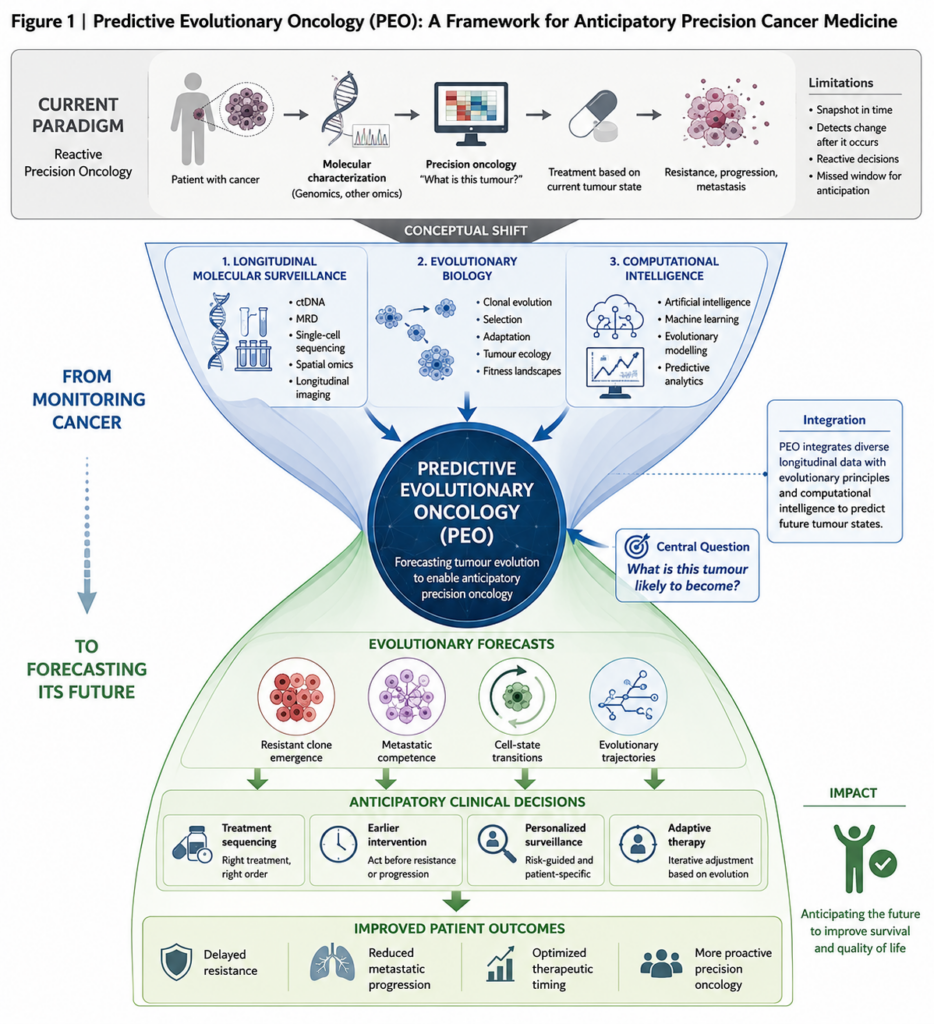
This convergence marks a pivotal moment for cancer research. Rather than pursuing progressively finer descriptions of tumour biology, oncology is increasingly positioned to ask a more ambitious question: ‘What is this tumour likely to become?’ In this Perspective, we propose Predictive Evolutionary Oncology (PEO) as a conceptual framework that integrates evolutionary biology, longitudinal molecular surveillance and computational intelligence into a forward-looking model of cancer care. Our central argument is that the next major advance in precision oncology will be defined not by more precise characterization of tumours, but by the ability to anticipate their evolutionary trajectories and intervene before adaptation becomes clinically manifest. The future of precision oncology, we argue, lies in moving from monitoring cancer to forecasting its future [16,17,19,20].
Why Forecasting Matters
Forecasting has long occupied an uncertain place in oncology, not because tumour evolution was thought to be biologically irrelevant, but because it appeared intrinsically unpredictable. Clinical practice has therefore focused on documenting evolutionary change after it becomes measurable rather than anticipating it before it becomes clinically consequential. This reactive paradigm reflected the limits of available biological information as much as the complexity of cancer itself [2,3].
That limitation is beginning to change. The convergence of longitudinal molecular profiling, circulating tumour DNA analysis, measurable residual disease monitoring, single-cell and spatial technologies now allows tumours to be observed repeatedly across their evolutionary course rather than at isolated clinical snapshots. These advances do more than increase the quantity of data—they fundamentally alter its structure. Cancer is becoming a continuously observable biological process [9,10,12,14]
This distinction is critical because prediction does not emerge from artificial intelligence alone. It emerges when sufficiently informative longitudinal biology is coupled with computational models capable of identifying recurrent evolutionary patterns. Artificial intelligence can recognize trajectories only when biology is observed through time. In this sense, the principal innovation is not simply more powerful algorithms, but a transformation in how tumour evolution is measured [12,15]
The implications extend beyond improved disease monitoring [17,19,20]. If evolutionary trajectories can be estimated before resistant clones dominate or metastatic programmes become clinically evident, prediction itself becomes therapeutically meaningful. Forecasts need not eliminate uncertainty to influence clinical care; they need only identify probable futures with sufficient confidence to guide intervention. Modern medicine routinely relies on probabilistic decision-making, and oncology may now be approaching a point where evolutionary forecasting can serve a similar role.
The question is therefore no longer whether forecasting tumour evolution is conceptually possible, but how such forecasts should be integrated into precision oncology. Addressing that challenge requires a framework that treats evolutionary prediction not as an isolated computational exercise but as a foundation for clinical decision-making [3,20]. We propose that this framework is Predictive Evolutionary Oncology.
Predictive Evolutionary Oncology
The convergence of longitudinal molecular surveillance, evolutionary biology and computational modelling now makes it possible to reconsider what precision oncology should ultimately seek to achieve [9,15,20]. We propose Predictive Evolutionary Oncology (PEO) as a conceptual framework that extends precision medicine beyond increasingly accurate tumour characterization toward prospective estimation of tumour evolutionary trajectories. PEO is not intended to replace precision oncology; rather, it represents its logical progression. If precision oncology asks, ‘What is this tumour?’, Predictive Evolutionary Oncology asks, ‘What is this tumour likely to become?’
This distinction is more than semantic. Contemporary precision oncology is largely organized around identifying actionable molecular states at the time of clinical evaluation. Although enormously successful, this approach remains predominantly state-based. PEO introduces trajectory as an equally important dimension of clinical reasoning. Rather than viewing resistance, metastasis or phenotypic plasticity as events to be detected after they emerge, the framework treats them as evolutionary processes whose future direction may be estimated from longitudinal biological evidence. In this sense, the objective shifts from precision characterization to precision anticipation [2,3,4,18].
Importantly, PEO should not be understood as synonymous with artificial intelligence, adaptive therapy or evolutionary oncology alone. Artificial intelligence provides analytical capability, evolutionary biology provides theoretical foundations and longitudinal profiling supplies the biological substrate [15,17,20]. Predictive Evolutionary Oncology is the synthesis of these disciplines into a clinically oriented framework whose purpose is to transform evolutionary forecasts into actionable therapeutic insight. Its novelty therefore lies not in any single technology, but in integrating parallel advances around a common clinical objective.
Like all predictive disciplines, PEO will operate within probabilistic rather than deterministic boundaries. Forecasts of tumour evolution will inevitably carry uncertainty, and not every evolutionary trajectory will be predictable. Yet clinical usefulness does not require certainty. The relevant question is whether anticipating likely evolutionary futures can improve therapeutic timing, treatment selection and patient outcomes compared with strategies that remain exclusively reactive [19,20]. Framed in this way, Predictive Evolutionary Oncology is less a claim of perfect prediction than a proposal for a new operating principle in precision cancer medicine.
From Prediction to Anticipation: Redefining Clinical Decision-Making in Oncology
Forecasting tumour evolution has little clinical value if it merely improves biological understanding. Its significance lies in whether it changes therapeutic action. The central premise of Predictive Evolutionary Oncology is therefore not that cancer can be predicted with certainty, but that anticipating probable evolutionary trajectories may create opportunities to intervene before adaptation becomes clinically dominant [17,19,20]. In this framework, prediction is transformed into anticipation, and anticipation becomes the basis for a more proactive model of cancer care
This perspective reframes the objective of clinical decision-making. Contemporary oncology typically modifies treatment in response to measurable progression, acquired resistance or radiographic evidence of disease evolution. Predictive Evolutionary Oncology instead proposes that treatment decisions should increasingly be informed by where a tumour is likely to move rather than solely by where it has already arrived. The conceptual shift is subtle but profound: therapeutic strategies become guided by anticipated evolutionary change rather than exclusively by established biological events [4,17,20].
Perhaps the most important implication of this framework is that time itself becomes a therapeutic variable. Precision oncology has transformed how clinicians select therapies based on molecular characteristics. Predictive Evolutionary Oncology extends this logic by emphasizing when interventions should occur in relation to tumour evolution. Forecasts of resistant clone expansion, cell-state transitions or metastatic competence may reveal therapeutic windows that remain invisible within reactive models of care [4,12,17,19]. The goal is no longer simply to suppress resistance after it emerges, but to alter its evolutionary trajectory before it becomes clinically consequential.
Although the clinical implementation of this framework will require prospective validation, robust computational models and carefully designed trials, its potential implications are already evident. Evolutionary forecasts could influence treatment sequencing, surveillance strategies, adaptive therapeutic approaches and the design of biomarker-driven clinical studies [15,19,20,22]. The defining question for future oncology may therefore no longer be whether tumours can be characterized with greater precision, but whether their evolutionary trajectories can be anticipated early enough to change clinical outcomes. This transition from prediction to anticipation provides the clinical foundation upon which the next era of precision oncology may be built.
The Next Frontier in Oncology
Every major transition in oncology has been defined by an expansion in what clinicians can know about cancer. Traditional oncology localized disease anatomically. Precision oncology transformed this paradigm by revealing the molecular state of individual tumours [1,5]. The next transition may be defined not by a new technology, but by a new capability: anticipating the future evolutionary behaviour of cancer. If this becomes achievable, the defining question of oncology will shift from ‘What is this tumour?’ to ‘What is this tumour likely to become?’
Realizing this vision will require advances that extend beyond algorithm development. Longitudinal, multimodal datasets, standardized evolutionary endpoints, prospective clinical validation and close collaboration among oncologists, evolutionary biologists, computational scientists and systems biologists will all be essential [10,15,19,20]. Equally important will be a change in scientific culture—from treating prediction as a speculative aspiration to evaluating it as a measurable and testable clinical objective.
Predictive Evolutionary Oncology should therefore be viewed neither as a replacement for precision oncology nor as a single technological innovation. Rather, it provides a conceptual framework for integrating evolutionary biology, longitudinal monitoring and computational prediction into a coherent model of anticipatory cancer care [9,15,20]. Its value will ultimately be judged not by how accurately it predicts every evolutionary event, but by whether those predictions improve therapeutic timing, clinical decisions and patient outcomes.
The history of oncology has been marked by successive efforts to understand cancer with increasing precision. We suggest that its next chapter may be written through time rather than through resolution alone. The future of precision oncology may therefore depend not only on characterizing tumours more comprehensively, but on anticipating their evolutionary trajectories early enough to alter them. The transition from monitoring cancer to forecasting its future is, in our view, not simply a technological ambition—it is a new scientific direction for precision cancer medicine
References
- Garraway LA, Verweij J, Ballman KV. (2013). Precision oncology: An overview. Journal of Clinical Oncology, 31(15), 1803–1805. https://doi.org/10.1200/JCO.2013.49.4799
- Greaves M, Maley CC. (2012). Clonal evolution in cancer. Nature, 481(7381), 306–313. https://doi.org/10.1038/nature10762
- Maley CC, Gatenby RA, Anderson ARA, et al. (2017). Classifying the evolutionary and ecological features of neoplasms. Nature Reviews Cancer, 17, 605–619. https://doi.org/10.1038/nrc.2017.69
- Dagogo-Jack I, Shaw AT. (2018). Tumour heterogeneity and resistance to cancer therapies. Nature Reviews Clinical Oncology, 15, 81–94. https://doi.org/10.1038/nrclinonc.2017.166
- Collins FS, Varmus H. (2015). A New Initiative on Precision Medicine. New England Journal of Medicine, 372(9), 793–795. https://doi.org/10.1056/NEJMp1500523
- Turajlic S, Swanton C. (2016). Metastasis as an evolutionary process. Science, 352(6282), 169–175. https://doi.org/10.1126/science.aaf2784
- McGranahan N, Swanton C. (2017). Clonal heterogeneity and tumour evolution: Past, present, and the future. Cell, 168(4), 613–628. https://doi.org/10.1016/j.cell.2017.01.018
- Merlo LMF, Pepper JW, Reid BJ, Maley CC. (2006). Cancer as an evolutionary and ecological process. Nature Reviews Cancer, 6, 924–935. https://doi.org/10.1038/nrc2013
- Wan JCM, Massie C, Garcia-Corbacho J, et al. (2017). Liquid biopsies come of age: Towards implementation of circulating tumour DNA. Nature Reviews Cancer, 17(4), 223–238. https://doi.org/10.1038/nrc.2017.7
- Heitzer E, Haque IS, Roberts CES, Speicher MR. (2019). Current and future perspectives of liquid biopsies in genomics-driven oncology. Nature Reviews Genetics, 20, 71–88. https://doi.org/10.1038/s41576-018-0071-5
- Miller CA, McMichael J, Dang HX, et al. (2022). The evolutionary history of human cancers. Nature, 608, 378–393. https://doi.org/10.1038/s41586-022-05054-5
- Maynard A, McCoach CE, Rotow JK, et al. (2020). Therapy-induced evolution of human lung cancer revealed by single-cell RNA sequencing. Cell, 182(5), 1232–1251.e22. https://doi.org/10.1016/j.cell.2020.07.017
- Marusyk A, Janiszewska M, Polyak K. (2020). Intratumor heterogeneity: The Rosetta Stone of therapy resistance. Cancer Cell, 37(4), 471–484. https://doi.org/10.1016/j.ccell.2020.03.007
- Lewis SM, Asselin-Labat ML, Nguyen Q, et al. (2021). Spatial omics and multiplexed imaging to explore cancer biology. Nature Methods, 18, 997–1012. https://doi.org/10.1038/s41592-021-01203-6
- Chang TG, Park S, Schäffer AA, et al. (2025). Hallmarks of artificial intelligence contributions to precision oncology. Nature Cancer, 6, 417–431. https://doi.org/10.1038/s43018-025-00917-2
- Gatenby RA, Brown JS. (2020). The evolution and ecology of resistance in cancer therapy. Cold Spring Harbor Perspectives in Medicine, 10, a040972. https://doi.org/10.1101/cshperspect.a040972
- Gatenby RA, Silva AS, Gillies RJ, Frieden BR. (2009). Adaptive therapy. Cancer Research, 69(11), 4894–4903. https://doi.org/10.1158/0008-5472.CAN-08-3658
- Turajlic S, Sottoriva A, Graham T, Swanton C. (2019). Resolving genetic heterogeneity in cancer. Nature Reviews Genetics, 20, 404–416. https://doi.org/10.1038/s41576-019-0114-6
- Jamal-Hanjani M, Wilson GA, McGranahan N, et al. (2017). Tracking the evolution of non-small-cell lung cancer (TRACERx). New England Journal of Medicine, 376, 2109–2121. https://doi.org/10.1056/NEJMoa1616288
- Gatenby RA, Brown JS. (2020). Integrating evolutionary dynamics into cancer therapy. Nature Reviews Clinical Oncology, 17, 675–686. https://doi.org/10.1038/s41571-020-0411-1
- Abbosh C, Birkbak NJ, Swanton C. (2018). Early stage NSCLC—challenges to implementing precision medicine. Nature Reviews Clinical Oncology, 15, 577–586. https://doi.org/10.1038/s41571-018-0058-3
- Meric-Bernstam F, Brusco L, Shaw K, et al. (2015). Feasibility of large-scale genomic testing to facilitate enrollment onto genomically matched clinical trials. Journal of Clinical Oncology, 33(25), 2753–2762. https://doi.org/10.1200/JCO.2014.60.4165